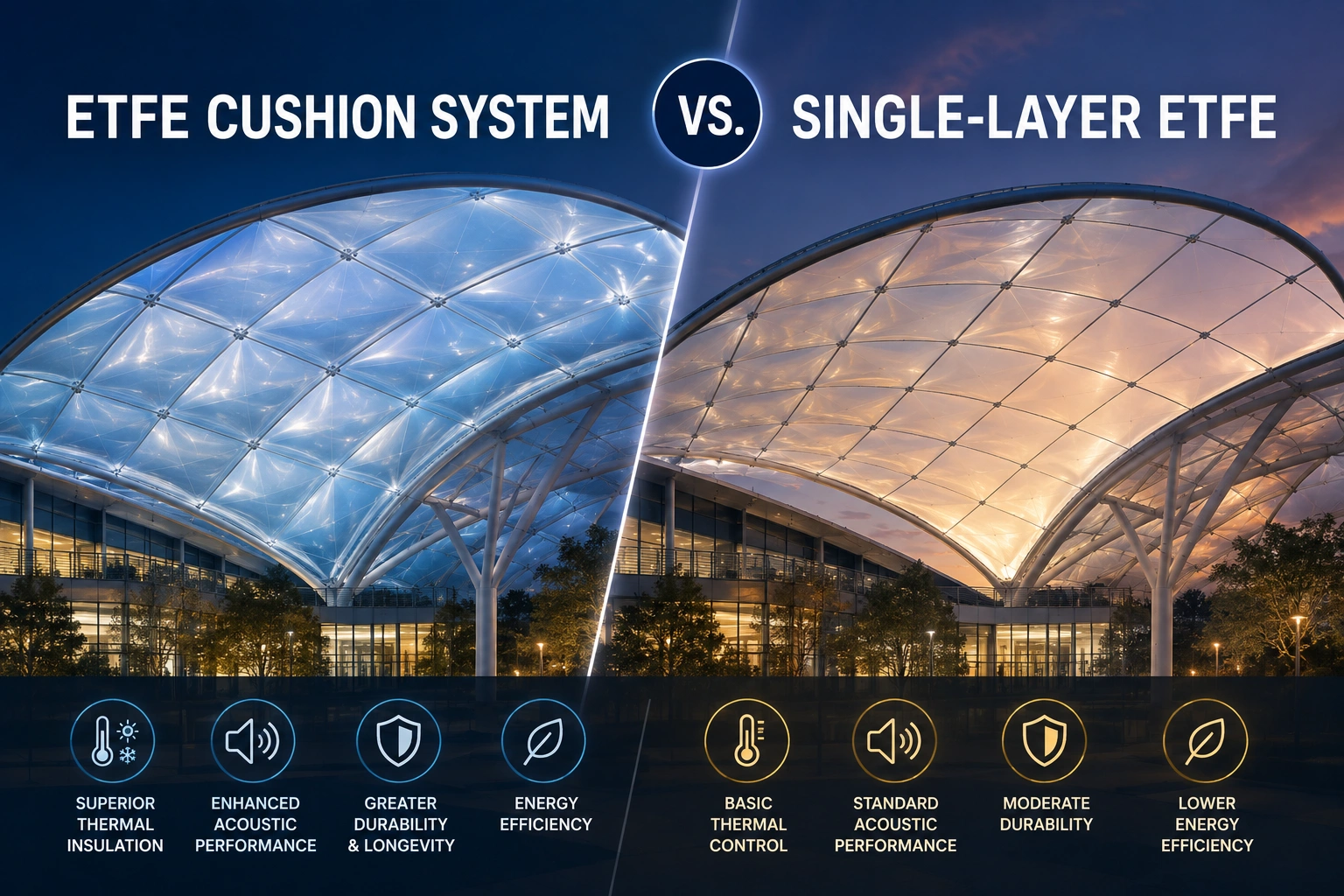
ETFE has become a practical option for roofs, atriums, canopies, and transparent facades. The global ETFE market is also expected to reach US$584.3 million in 2026. Grand View Research projects a 6.7% CAGR from 2025 to 2030, reflecting its growing use in modern building projects. The key design choice is often between a single ETFE membrane and an inflated multi-layer system. Both systems use the same basic polymer, but they work in very different ways. A single membrane requires mechanical support, whereas a cushion uses controlled air pressure to maintain its shape. This affects insulation, loads, maintenance, controls, and cost. Your choice should therefore start with the building brief, climate, span, daylight target, and indoor comfort needs. A system that works well for an open canopy may be a poor fit for an enclosed building.
In this guide, we will explain how single-layer and ETFE cushion systems differ, where each option works best, and what you should consider before selecting one for a modern facade.
What Is The Difference Between An ETFE Cushion And A Single Membrane?
The key difference is how the foil gets its shape and support. A single membrane is tensioned over a supporting frame, cable net, or similar structure. It does not need an air supply. A cushion uses two or more foil layers joined at their edges and inflated with low-pressure air. The pressure keeps the layers apart and gives the system its form. Architen Landrell describes cushion pressures in the range of about 200–300 Pa, while the academic literature reports typical values of about 250–400 Pa.
Here is the basic comparison:
| Factor | Single ETFE membrane | Multi-layer ETFE cushion |
|---|---|---|
| Support | Cable or structural frame | Perimeter frame plus air pressure |
| Inflation | Not required | Required continuously |
| Layers | One | Usually two to four |
| Insulation | Limited | Better as layers increase |
| System controls | Simple | Pressure and fault monitoring required |
| Weight | Extremely low | Still much lighter than glass |
| Best fit | Canopies, walkways, open spaces | Atriums, roofs, enclosed facades |
| Maintenance | Relatively simple | Includes air-handling equipment |
| Solar control | Can use frit or printing | Can use multiple printed layers and pressure control |
Architen states that ETFE can weigh about 1% as much as glass and can transmit up to 95% of visible light. Its systems range from single-layer membranes to two-, three-, and four-layer cushions.
When Should You Choose A Single-Layer ETFE Facade?
A single membrane makes sense when your main goal is a lightweight weather cover rather than a highly insulated building envelope.
Architen's single-layer approach does not need inflation equipment. That removes fans, air pipes, pressure monitoring, and the need for a continuous power connection. This can make the system easier to operate on small structures.
Here's where the simpler approach can work well:
- Open-air walkways
- Entrance canopies
- Covered courtyards
- Shading structures
- Semi-enclosed public spaces
- Projects where insulation is a low priority
The low weight of ETFE can help reduce structural loads, although the required supporting system depends on the membrane geometry and design loads. The trade-off is that you do not get the trapped-air layer found in a multi-layer cushion.
That matters when your facade separates an occupied, conditioned interior from the outside environment.
How Does An ETFE Cushion Improve Insulation?
The main benefit of a cushion is the air space between the foil layers.
Architen reports approximate U-values of 2.9 W/m²K for two layers, 1.8 W/m²K for three layers, and 1.4 W/m²K for four layers. A single ETFE membrane is around 5.6 W/m²K in its guide. Lower U-values indicate lower heat transfer through the envelope.
Here's what the extra layers change:
- Two layers create one insulated air pocket.
- Three layers create two air pockets.
- Four layers create three air pockets.
- Printed or fritted layers can also reduce solar transmission.
- Automated systems can adjust light transmission in response to sunlight.
Architen's Intelligent Printing system uses pressure to move printed layers closer together or farther apart. This changes the amount of light passing through the cushion.
This makes cushions more suitable for buildings where daylight and solar control need to be considered together.
Does ETFE Provide Good Acoustic Performance?
ETFE should not be treated as a direct replacement for a heavy acoustic wall or high-performance glazed assembly.
The lightweight foil has limited mass, so sound can pass through it more easily than through heavy construction. Rain noise can also become an issue. Architen notes that inflated cushions can behave somewhat like a drum when rain hits the outer layer.
Here's how designers can address that issue:
- Add a rain-suppression mesh.
- Use additional membrane layers.
- Combine ETFE with other building materials where sound control is important.
- Assess the facade as a complete assembly rather than judging the foil alone.
Architen's acoustic mesh can reduce rain-related sound by up to 10 dB, according to the company's published product data.
So, acoustic attenuation depends heavily on the complete roof or facade design. A cushion can offer useful sound control, but it should not be specified on the assumption that extra ETFE layers automatically solve every acoustic problem.
How Does Pneumatic Stabilization Work In Large ETFE Structures?
An inflated cushion needs a controlled air supply to maintain its shape.
Air pipes connect individual cushions to an air-handling unit. Architen explains that the unit maintains pressure rather than continuously producing high airflow. Its systems can also monitor pressure, temperature, humidity, weather conditions, and faults.
Here's what the control system typically manages:
- Cushion pressure
- Fan operation
- Pressure-loss response
- Fault alarms
- Humidity control
- Remote system diagnostics
- Air supply to individual cushions
For large projects, redundancy matters. Architect's technical guidance notes that larger installations can use multiple air-handling units that are networked for load sharing.
This is one of the main differences from a single membrane. A cushion is a building system, not simply a sheet of foil.
Which Option Works Better For Long Spans?
The answer depends on the structural concept, but cushions are often well suited to large transparent roofs and facades.
Taiyo Europe describes ETFE as suitable for applications ranging from skylights to large-span structures and building facades. Its TensoSky system can be configured as a two- or three-layer air-filled cushion or as a single-layer cable-supported structure.
Here's what makes cushions useful on large projects:
- Low dead load
- Large transparent areas
- Flexible geometry
- Reduced structural demand compared with heavy glazing
- Ability to integrate printed patterns
- Potential for controlled solar transmission
Vector Foiltec also highlights the low structural weight of ETFE and its use in large-span roofs, stadiums, airports, and other major buildings. Its Asia-Pacific operation focuses on durability, solar control, and lightweight construction for demanding climates.
This is where ETFE can become particularly useful for long-span structural systems, where reducing dead load can affect the supporting frame and foundations.
What Should You Check Before Specifying ETFE?
The right specification starts with performance requirements, not appearance.
CForce, for example, should assess the complete structural and facade brief before selecting a membrane arrangement rather than treating all ETFE applications as interchangeable. CForce published portfolio includes a 45 × 11 metre multi-layer ETFE cushion canopy at Shura Island and an ETFE cushion roof structure in Al Khobar.
Here's a practical checklist for the design team:
- Required span and geometry
- Wind and snow loads
- Indoor temperature targets
- Solar exposure
- Daylight requirements
- Rain noise
- Fire strategy
- Drainage
- Access for maintenance
- Backup power for pneumatic equipment
- Pressure monitoring
- Expected service life
- Connection details
- Cleaning and inspection requirements
A 2026 study published in Energy and Buildings also points to the need for careful thermal modelling of ETFE cushion buildings because their thermal behaviour can be more complex than simplified design assumptions suggest.
ETFE Cushion Or Single Layer: Which One Should You Choose?
Use a single membrane when the project needs a lightweight transparent cover and does not require a high level of thermal separation.
Use a cushion when the facade or roof is part of an occupied, conditioned space and you need better insulation, solar control, or a more controlled building envelope.
The decision should also account for the supporting structure and services. A single layer removes pneumatic equipment but may require a different structural arrangement. A cushion adds mechanical systems but can provide better thermal performance and greater control over daylight.
There is no universal winner. The better choice is the one that matches the building's actual performance targets.
Conclusion
ETFE gives architects a useful choice between simple tensioned membranes and more controlled multi-layer systems. Single membranes suit lightweight covers and open spaces. Cushions make more sense when insulation, solar control, large spans, and indoor comfort carry greater weight.
The best specification comes from looking at the whole facade system. That means checking the structure, climate, air-handling equipment, daylight, sound, maintenance, and operating requirements together. CForce ETFE work also shows how cushion systems can be applied to large architectural structures, but each project still needs its own engineering assessment.
For modern facades, the choice is therefore less about choosing the most advanced option and more about matching the membrane system to the building's actual needs.
FAQs
1. Is a single ETFE membrane insulated?
No. A single membrane has limited thermal resistance. Multi-layer cushions perform better because the air pockets between the foil layers reduce heat transfer.
2. Does an ETFE cushion need electricity?
Yes. An inflated cushion needs an air-handling unit to maintain pressure. The power demand is relatively low, but the system needs a reliable electrical supply and suitable controls.
3. Can ETFE be used for building facades?
Yes. ETFE can be used as a single membrane or as multi-layer cushions on roofs and facades. The final design depends on structural loads, climate, daylight, thermal requirements, and the building's use.
4. Are ETFE cushions noisy when it rains?
They can be. Rain striking an inflated cushion may create a drum-like sound. A rain-suppression mesh can reduce this effect, and Architen reports sound reduction of up to 10 dB for its acoustic mesh system.
