ETFE Skylight vs Glass Skylight
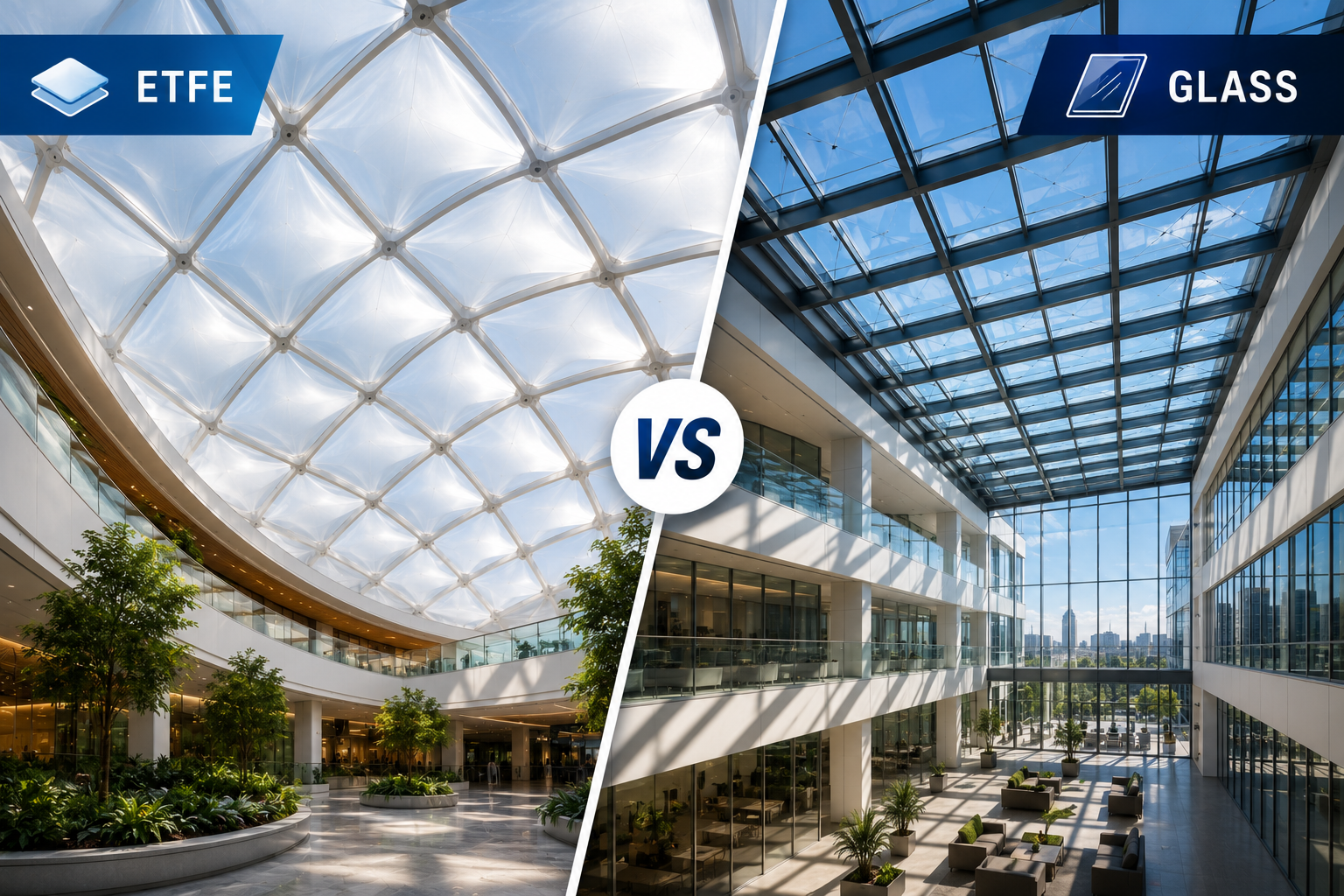
ETFE Skylight vs Glass Skylight
The Ultimate 2026 Structural & Thermal Comparison for Commercial Architecture
Commercial skylights in 2026 must meet structural, thermal, and lifecycle performance requirements. They must achieve these objectives without adding unnecessary weight to the building envelope. This makes material selection even more important. The material you choose will directly affect steel consumption, foundation loads, installation methods, energy performance, and long-term maintenance costs.
According to the U.S. Department of Energy, properly designed daylighting systems that incorporate windows and skylights can reduce lighting energy demand while also helping manage heating and cooling loads. As a result, skylight selection influences not only daylight availability but also the overall energy performance of the building envelope. Against this backdrop, ETFE has emerged as a practical alternative to conventional glass for many large-span commercial applications.
This guide compares ETFE vs Glass from an engineering perspective, helping architects, structural engineers, façade consultants, developers, and quantity surveyors evaluate which system best aligns with project requirements.
ETFE vs Glass
Ethylene Tetrafluoroethylene (ETFE) is a high-performance fluoropolymer used in commercial roofing and façade systems as a lightweight transparent membrane. Manufacturers typically supply ETFE as thin foil sheets ranging from approximately 100 to 300 microns thick. Depending on the project's thermal and structural requirements, designers install the material as a single-layer membrane or as multi-layer pneumatic cushions supported within aluminium framing systems. Continuous low-pressure air inflation maintains the cushion geometry while improving thermal performance and structural stability.
Glass skylights use rigid glazing assemblies manufactured from tempered, laminated, or insulated glass units (IGUs). These systems rely on aluminium or steel framing to support their considerably higher dead load while meeting structural, thermal, and safety requirements. Project specifications often determine the glazing configuration, including Low-E coatings, laminated interlayers, gas-filled cavities, or solar-control treatments, to achieve the required daylight transmission, insulation, and occupant comfort.
Although both systems provide natural daylight, they achieve structural performance through fundamentally different design approaches.
Comparison of Material Properties of ETFE and Glass
Here is how ETFE and glass skylight differ from each other based on material properties:
| Property | ETFE Skylight | Glass Skylight |
|---|---|---|
| Material | Fluoropolymer foil | Tempered or laminated glass |
| Typical Weight | Approximately 1% of equivalent glass | Significantly higher dead load |
| Visible Light Transmission | Up to 95% | Typically 70–90% depending on coating |
| Structural Behaviour | Flexible membrane | Rigid panel |
| Typical Lifespan | 30–50 years | 30+ years with proper maintenance |
| Typical Applications | Stadiums, atriums, airports, exhibition halls | Offices, retail buildings, institutional projects |
Structural Dead Load Comparison
Structural dead load remains one of the most significant differences in the ETFE vs Glass comparison.
A conventional insulated glass skylight introduces substantial permanent loading that affects rafters, trusses, supporting beams, and foundations. ETFE cushions, by contrast, weigh only a fraction of comparable glazing systems.
Lower structural dead load provides measurable engineering benefits:
- Reduced structural steel tonnage.
- Smaller primary and secondary framing members.
- Lower foundation loading.
- Reduced lifting equipment requirements during installation.
- Faster roof assembly on large-span projects.
For commercial developments covering thousands of square meters, these reductions influence fabrication costs, transportation, crane selection, and installation schedules. Quantity surveyors often evaluate these indirect savings alongside the material cost because supporting steel frequently represents a significant percentage of the roof package.
Projects requiring free-form geometries or long-span roofs also benefit from ETFE's flexibility, allowing designers to reduce structural complexity without compromising daylight penetration.
Thermal Insulation and Building Envelope Performance
Thermal performance depends on the complete skylight assembly rather than the glazing material alone.
Modern glass skylights commonly use double or triple insulated glazing units with Low-E coatings and inert gas cavities to minimize conductive heat transfer. These systems generally provide superior U-values in highly conditioned buildings.
ETFE systems improve insulation by combining multiple foil layers with inflated air cushions. The trapped air reduces heat transfer while maintaining an exceptionally lightweight roof assembly.
| Performance Metric | ETFE Cushion System | Double or Triple Glazing |
|---|---|---|
| Structural Weight | Very low | High |
| Thermal Insulation | Good with multi-layer cushions | Excellent with insulated glazing units |
| Solar Control | Adjustable through frit patterns | Low-E coatings and tinting |
| Daylight Transmission | Excellent | Very good |
Buildings such as sports arenas, transport terminals, botanical gardens, and public atriums often prioritize weight reduction and daylight performance, making ETFE a practical double-glazing alternative where structural efficiency outweighs maximum thermal resistance.
For office buildings or healthcare facilities with strict indoor climate requirements, insulated glass continues to provide advantages because of its superior thermal and acoustic performance.
Structural Movement, Durability and Environmental Performance
Commercial roofs experience thermal expansion, wind uplift, snow loading, and structural deflection throughout their service life.
Unlike rigid glazing, ETFE accommodates movement through membrane flexibility, reducing stress concentrations that may otherwise affect framing connections. The material also resists UV degradation, corrosion, and many airborne pollutants, allowing it to retain optical performance over decades.
From a sustainability perspective, ETFE contributes to sustainable roofing strategies in several ways:
- Lower transport emissions due to reduced material weight.
- Reduced structural steel demand.
- Fully recyclable material.
- Lower maintenance requirements because of its non-stick surface.
- Lower water consumption during cleaning.
These characteristics support carbon footprint mitigation throughout the building lifecycle, particularly for large commercial developments where structural material quantities significantly influence embodied carbon calculations.
Installation, Maintenance and Lifecycle Cost
Installation methodology differs substantially between the two systems. Glass skylights require careful handling, heavier lifting equipment, and rigid structural framing. Installation durations increase as panel sizes and glazing thickness grow.
ETFE cushions arrive as lightweight membrane systems that crews install using aluminum perimeter frames and controlled inflation equipment. The reduced weight simplifies logistics and allows faster installation across extensive roof areas.
Maintenance profiles also differ.
Glass requires routine cleaning and periodic inspection of seals, gaskets, and glazing units. ETFE's smooth surface naturally sheds dirt during rainfall, reducing cleaning frequency. Facility managers should still inspect inflation systems, anchorage components, and control equipment as part of scheduled maintenance programs.
When evaluated over the full service life, many commercial projects achieve lower overall ownership costs through reductions in supporting steel, installation time, maintenance, and replacement logistics rather than membrane cost alone.
Where ETFE Outperforms Glass and Where Glass Remains the Better Choice
| Choose ETFE When... | Choose Glass When... |
|---|---|
| The project requires large unsupported spans. | High acoustic insulation is essential. |
| Structural weight must remain low. | Maximum thermal insulation is the primary objective. |
| The design includes free-form roof geometry. | Occupant comfort requires premium insulated glazing. |
| Daylighting across expansive public spaces is a priority. | Smaller commercial skylights require rigid glazing systems. |
| Construction logistics favour lightweight materials. | Building codes or specifications require insulated glass assemblies. |
Material selection should always reflect structural requirements, occupancy type, climate conditions, operational costs, and project performance objectives rather than a single performance metric.
Conclusion
The ETFE vs Glass decision extends well beyond transparency. Structural dead load, thermal insulation, lifecycle cost, maintenance, installation complexity, and sustainability all influence specification decisions for commercial architecture.
For long-span roofs, transport hubs, stadiums, exhibition centers, and large atriums, ETFE delivers substantial structural advantages by reducing permanent loads and lowering steel requirements while maintaining high daylight transmission. Glass remains the preferred solution where thermal and acoustic insulation take precedence.
At CForce, we work with architects, structural engineers, developers, and façade consultants to specify ETFE skylight and roofing systems that align with structural, environmental, and commercial project objectives. Contact our engineering team to discuss the most suitable skylight solution for your next commercial development.
Frequently Asked Questions
Is ETFE stronger than glass for commercial skylights?
ETFE offers higher flexibility and impact resistance, while glass provides greater rigidity. The better option depends on structural design requirements rather than material strength alone.
How much does ETFE reduce structural dead load?
ETFE typically weighs around 1% of an equivalent glass system, allowing engineers to reduce supporting steel and foundation loading on many commercial projects.
Can ETFE replace double-glazed skylights?
Yes, in many large-span commercial applications. However, insulated glass generally provides higher thermal and acoustic insulation for conditioned buildings.
How long do ETFE skylights last?
Properly designed ETFE systems commonly achieve service lives between 30 and 50 years while maintaining UV resistance and light transmission.
Is ETFE suitable for sustainable roofing?
Yes. Its lightweight construction, recyclability, lower transport requirements, and reduced steel demand support sustainable roofing strategies and carbon footprint mitigation.
Which commercial buildings benefit most from ETFE skylights?
Stadiums, airports, exhibition centers, shopping malls, transport hubs, botanical gardens, and large atriums frequently specify ETFE because of its lightweight structural performance.
Does glass still offer advantages over ETFE?
Yes. Glass remains the preferred solution where projects demand premium acoustic insulation, high thermal performance, or rigid glazing assemblies for enclosed conditioned spaces.
