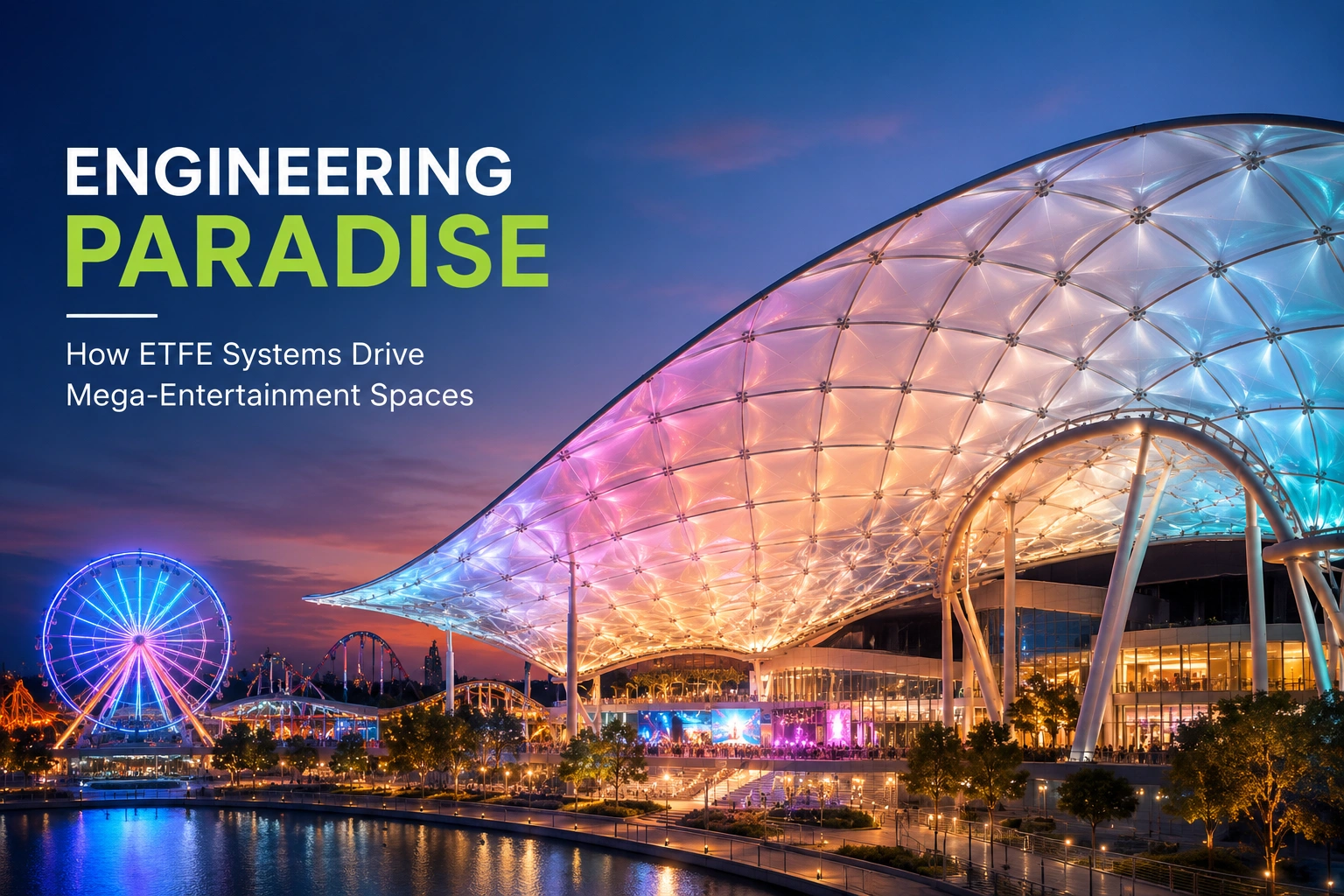
Large coastal resorts need structures that are light, durable, and suited to strong sun. ETFE can help meet these needs. The material is a lightweight fluoropolymer used in roofs, façades, skylights, and cushion systems. At Shura Island, CForce Group reports that it designed and installed multi-layer ETFE cushion canopies measuring 45 × 11 metres. The system uses continuous mechanical air pressure to hold the cushion shape. This makes the project a useful case for studying how ETFE can support spaces at The Red Sea entertainment while keeping structural weight low. The wider sustainability strategy is also measurable: in July 2026, Red Sea Global reported that 10 hotels and resorts at The Red Sea had achieved LEED Platinum certification, covering 1,207 keys and 236,405 square metres of certified area.
Why ETFE Fits Large Coastal Projects
ETFE is a thin fluoropolymer film. It is much lighter than glass and can transmit a high amount of daylight. It also resists UV exposure, moisture, and many chemicals. These properties matter in large buildings where roof weight, daylight, and long-term weather exposure affect the design.
For a large resort or public venue, an ETFE system can also cover wide areas without requiring a heavy glazed roof. This can reduce the load placed on the supporting steel structure.
ETFE can be used in two main ways:
- Single-layer systems: A membrane is fixed over a supporting frame.
- Cushion systems: Two or more ETFE layers are sealed around their edges and kept inflated with low-pressure air.
Cushion systems need an air-handling unit to maintain pressure. Technical guidance places typical operating pressure in the range of about 250–300 Pa, although the exact design depends on the system.
Shura Island: A Practical ETFE Case Study
Shura Island is the main hub of the Red Sea destination. Foster + Partners developed its Coral Bloom concept around the island's natural setting. The wider development includes 11 resorts, 305 residences, an 18-hole golf course, a marina, retail, dining, and leisure facilities.
CForce's published project information gives a specific ETFE application on the island. Its multi-layer cushion canopies have a reported 45 × 11 metre span. The company states that the cushions use continuous mechanical air blowing to maintain their shape, firmness, and stability. It also reports the use of coloured ETFE film with customised printing.
That detail matters because it shows where ETFE becomes useful beyond a simple transparent roof. Printed or coloured film can control the visual character of a canopy while the cushion system provides the required form.
How The Cushion System Works
An ETFE cushion is not a rigid roof. Its shape comes from air pressure.
A typical system includes:
- ETFE foil layers
- A supporting steel or aluminium frame
- Edge fixing and sealing components
- Air supply pipes
- Fans or air-handling equipment
- Pressure monitoring and control
The air system keeps the membrane under tension. This allows the cushion to resist external loads while remaining lightweight. Research on ETFE cushions also shows that pressure can be used with intermediate foil layers to change solar transmission in more advanced systems.
For coastal entertainment structures, this approach has another benefit. The membrane can form curved or organic shapes without the weight associated with large areas of glass.
ETFE and Sustainable Mega-Projects
Sustainability cannot be judged from one material alone. A building's energy use, structure, transport, construction, maintenance, and operation all matter.
Still, ETFE can contribute at the component level. Its low weight can reduce structural demand. Its high daylight transmission can support daylighting strategies. Its resistance to UV exposure and its non-stick surface can also reduce some maintenance requirements.
This is relevant to sustainable mega-projects, where even small changes in material weight can affect large areas of construction.
The Red Sea development takes a wider approach. Red Sea Global states that Shura Island is powered by renewable energy from the destination's solar farms and supported by large-scale battery storage. In July 2026, five operational Shura Island hotels received LEED Platinum certification.
So, ETFE should be viewed as one part of a larger building strategy rather than as proof of sustainability by itself.
From Resort Roofs To Entertainment Spaces
The Red Sea destination is designed around resorts, dining, retail, leisure, and other visitor facilities. Red Sea Global also announced the launch of ADRENA, an adventure and entertainment district, in early 2026.
This creates a need for structures that can provide shade while maintaining an open visual connection with the surrounding coast.
ETFE is suited to this type of application because designers can use it for:
- Canopies over public areas
- Covered walkways
- Atrium roofs
- Resort entrance structures
- Event spaces
- Skylights
- Lightweight façades
In this setting, coastal entertainment structures need to do more than provide shelter. They must handle sun, wind, moisture, maintenance needs, and the visual requirements of a high-end destination.
What The Shura Project Teaches Designers
The Shura application offers several useful lessons for Saudi Vision 2030 architecture.
| Design factor | ETFE approach | Why it matters |
|---|---|---|
| Structural weight | Very lightweight membrane | Can reduce roof loads |
| Daylight | High light transmission | Supports natural daylight |
| Form | Flexible foil and cushions | Allows curved forms |
| Solar control | Printing and multi-layer systems | Can manage light and heat |
| Weather exposure | Strong UV and weather resistance | Useful for outdoor environments |
| Maintenance | Low-friction surface | Can reduce dirt retention |
| Air support | Low-pressure inflation system | Maintains cushion geometry |
| Visual design | Coloured and printed film | Supports customised appearance |
These factors are particularly relevant when designing premium resort facades and roofs where appearance, climate response, and structural efficiency must work together.
The Wider Red Sea Design Strategy
The value of Shura Island is not limited to one material. The island forms part of a much larger development strategy.
Red Sea Global describes the destination as covering about 28,000 square kilometres and more than 90 islands. Its current portfolio includes 18 hotels with around 3,000 keys, more than 1,000 residential homes, and 760,000 solar panels.
The island itself uses lightweight structures, native landscaping, renewable energy, and low-impact construction as part of its design approach.
This shows why material selection matters at project scale. A roof system may occupy only one part of a resort, but its weight, daylight performance, maintenance needs, and construction method can affect the wider building design.
For Saudi Vision 2030 architecture, this type of thinking is increasingly relevant. Large tourism developments need to combine ambitious design with measurable building performance.
A Useful Model For Future Coastal Projects
The Shura example suggests a simple way to assess ETFE for future developments:
Start with climate.
Check solar exposure, wind, humidity, dust, and temperature.
Define the function.
Decide whether the membrane is providing shade, daylight, weather protection, or a combination.
Choose the system.
A single-layer membrane and an inflated cushion have different structural and performance requirements.
Plan the support system.
ETFE is lightweight, but it still needs a properly engineered frame, edge connection, drainage, and air
system where cushions are used.
Measure performance.
Look at daylight, solar gain, energy use, maintenance, material life, and replacement requirements.
This approach is more useful than selecting ETFE simply because it has a futuristic appearance.
Conclusion
ETFE works best when its material properties match the needs of the building. The Shura Island canopy is a clear example. CForce reports a 45 × 11 metre multi-layer cushion system with continuous air support and printed coloured ETFE film.
At the wider project level, The Red Sea combines lightweight architecture with renewable energy, green-building certification, and large-scale tourism infrastructure. The July 2026 LEED milestone shows that these goals are being measured through recognised certification as the destination develops.
For future coastal entertainment structures, the lesson is simple: choose materials based on climate, structure, daylight, maintenance, and long-term performance. ETFE can be a strong option when those requirements align.
FAQs
1. What is ETFE used for in resort architecture?
ETFE is commonly used for lightweight roofs, canopies, skylights, façades, and cushion systems. Its low weight and high light transmission make it useful for large covered spaces.
2. How does an ETFE cushion stay inflated?
An air-handling system supplies low-pressure air through a network of pipes. The pressure keeps the ETFE layers tensioned and maintains the designed cushion shape.
3. What ETFE system was used at Shura Island?
CForce reports that the Shura Island project includes multi-layer ETFE cushion canopies measuring 45 × 11 metres. The system uses continuous mechanical air blowing and coloured ETFE film with customised printing.
4. How does ETFE support sustainable resort design?
ETFE's low weight can reduce structural demand, while its high daylight transmission can support daylighting. Its durability and resistance to UV exposure are also useful for long-term building performance. However, overall sustainability depends on the complete building design, not the membrane alone.
