Tensile structures & public spaces (Qiddiya project)
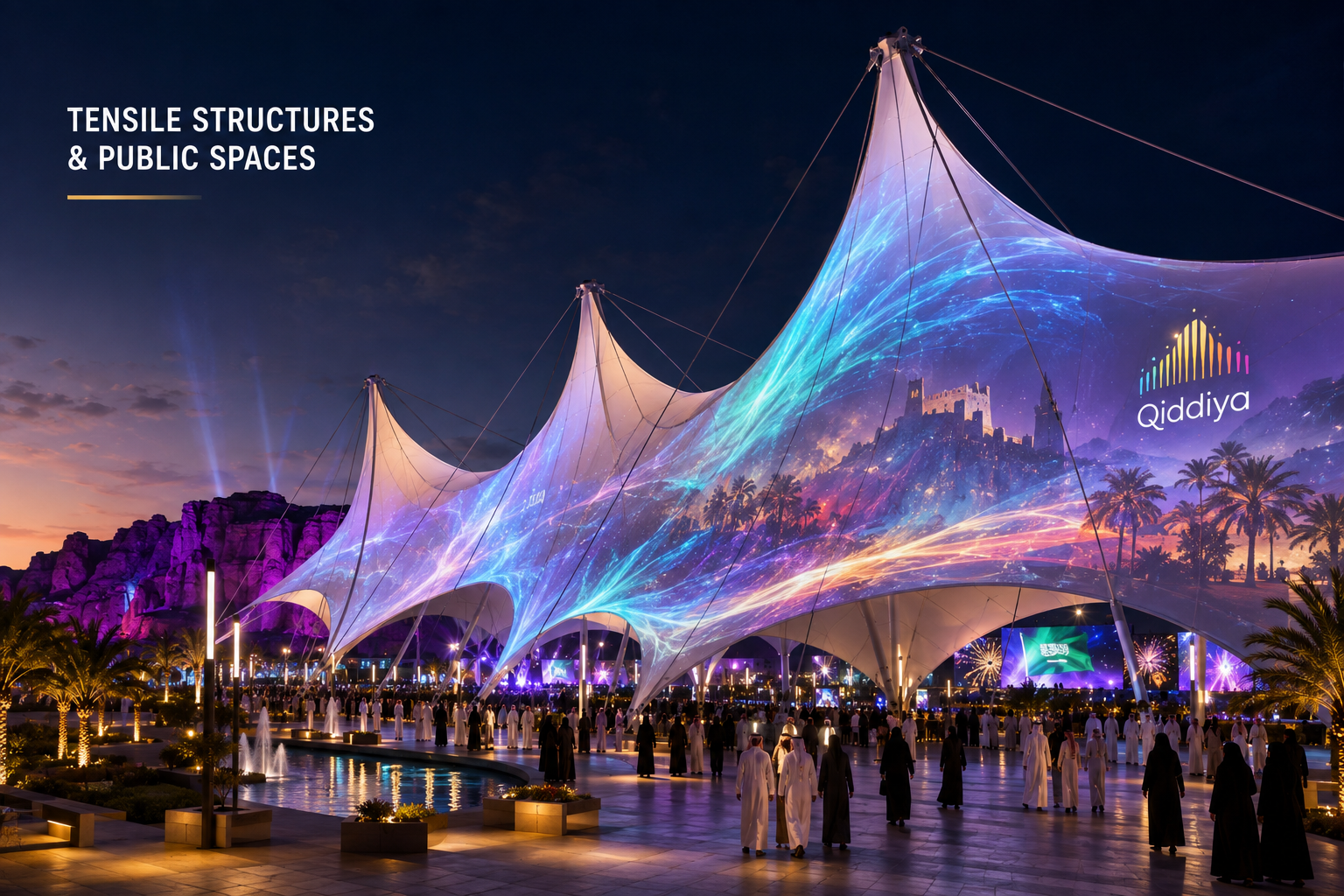
Tensile structures & public spaces (Qiddiya project)
Immersive Architectural Canvases: Integrating Tensile Structures with Advanced Projection Art for National Events
Public celebrations have evolved beyond traditional stages and decorative lighting. Today, audiences expect memorable environments that combine architecture, technology, and visual storytelling. This shift reflects broader trends across the global events industry. Fortune Business Insights reports that the events segment accounts for nearly 58% of the global projection mapping market, reflecting growing demand for immersive visual experiences at festivals, cultural programs, corporate events, and large public gatherings. Against this backdrop, tensile structures and projections have become a practical solution for creating large-scale, visually striking venues that transform open spaces into engaging destinations.
From national celebrations to cultural festivals, lightweight fabric structures offer the flexibility to host projection-driven experiences without the time and cost of permanent buildings. These lightweight fabric structures offer creative teams a versatile architectural surface while allowing event organizers to deliver memorable moments that leave a lasting impression.
Why Tensile Structures Are Ideal for Large Public Events
National celebrations often require venues that can accommodate thousands of visitors while supporting ambitious creative concepts. Permanent construction is not always practical for temporary programs, especially when events take place across different cities or outdoor locations.
Tensile structures solve this challenge through lightweight engineering and adaptable design. Unlike conventional buildings, these fabric systems can span large areas with minimal supporting elements, creating open interiors that improve audience movement and viewing angles.
Some of their key advantages include:
| Feature | Benefit for National Events |
|---|---|
| Lightweight construction | Faster transportation and installation across multiple venues |
| Large column-free spans | Clear viewing areas for audiences and projection displays |
| Flexible fabric surfaces | Supports curved architectural forms for creative visuals |
| Modular design | Allows expansion or customization for different event sizes |
| Weather-resistant materials | Suitable for outdoor celebrations in demanding climates |
Modern coated PVC fabrics also provide excellent light reflectivity. Their smooth white surfaces keep projected content bright, detailed, and visually consistent throughout an event.
For organizers planning large cultural celebrations or government ceremonies, these qualities make tensile structures an efficient investment that balances creativity with operational flexibility.
How Tensile Structures and Projection Mapping Transform Fabric Architecture
Projection mapping changes the way people interact with architecture. Instead of treating a structure as a static object, designers transform it into an active storytelling surface.
The process begins with a digital scan or 3D model of the structure. Designers recreate every curve, peak, and connection point inside specialized software. This virtual model allows artists to position graphics with precision before any equipment arrives on site.
Once the creative content is ready, powerful projectors display visuals that match every contour of the fabric. The audience does not simply watch a screen. They experience architecture that appears to move, shift, and respond through light.
Unlike flat projection surfaces, curved tensile forms create greater visual depth. Domes, arches, and flowing canopies introduce natural movement into every animation, making each presentation feel larger than life.
This combination of architecture and immersive media demonstrates how tensile structure & projection create environments that capture attention while supporting ambitious cultural programming.
Many premium tensile membrane systems comply with internationally recognized standards such as EN 13501 fire classification and ISO 9001 quality management.
Why Curved Fabric Creates Better Projection Surfaces
Curved geometry offers creative opportunities that flat walls cannot achieve.
Visual designers can:
- Wrap animations around the audience.
- Extend graphics across multiple connected surfaces.
- Simulate movement through architectural curves.
- Create illusion-based effects that change from different viewing angles.
- Blend lighting and projection into one continuous visual composition.
These capabilities encourage visitors to interact with the environment rather than simply observe it.
Building Immersive Experiences for National Celebrations
Major public events succeed when architecture, media, sound, and lighting work together as one experience.
Projection mapping becomes significantly more powerful when supported by thoughtful spatial design. Professional studios often use software platforms such as Disguise, TouchDesigner, Resolume Arena, MadMapper, or HeavyM to synchronize large-scale projection mapping.
360-Degree Visual Environments
Large fabric domes naturally surround audiences with imagery. Historical timelines, artistic performances, environmental themes, or cultural narratives can surround visitors from every direction. Instead of watching a presentation on a stage, guests become part of the visual environment itself.
This approach has become increasingly popular during national celebrations, heritage festivals, and founding day events across many countries.
Spatial Audio Integration
Audio should complement projected visuals rather than simply fill the venue. Multiple speaker zones allow sound to follow moving visuals across the structure. Birds, musical performances, historical narration, or animated graphics all gain greater impact when audiences hear movement matching what they see. The result feels coordinated instead of overwhelming.
Lighting Before and After Projection
LED lighting extends the visual experience before projectors even begin. Concealed LED fixtures positioned behind translucent fabric allow the structure to glow softly upon guest arrival. As the projection show begins, lighting transitions naturally into mapped visuals, creating a seamless change between architectural lighting and digital content.
This layered approach strengthens the relationship between physical construction and digital-physical architecture, giving creative teams greater freedom throughout the event schedule.
Technical Planning Considerations
Successful projection environments depend on careful planning long before installation begins.
Creative ambition alone cannot compensate for inadequate equipment or inaccurate calibration.
Selecting the Right Fabric
Projection quality starts with the fabric itself.
High-quality coated PVC membranes provide:
- High light reflectivity
- Smooth projection surfaces
- Weather resistance
- Fire safety compliance
- Long operational lifespan
Semi-translucent materials also allow internal lighting systems to enhance the venue before projection begins.
Choosing Suitable Projectors
Brightness determines whether visuals remain visible against surrounding ambient light. Outdoor national events often require projectors producing at least 20,000 lumens, while larger venues may combine multiple synchronized units to achieve consistent brightness across expansive surfaces.
Higher brightness also improves color accuracy and image contrast when audiences view content from longer distances.
Media Servers and Synchronization
Large installations rarely rely on a single projector. Media servers synchronize multiple projectors so every animation begins and ends at the same moment.
These systems also:
- Correct image distortion
- Blend overlapping projections
- Adjust brightness
- Manage playback schedules
- Support real-time content updates
Accurate synchronization keeps large installations visually consistent throughout the event.
Creative Possibilities Beyond Traditional Stage Design
Projection mapping allows architecture itself to become the performance.
Creative directors increasingly replace static stage backgrounds with moving architectural environments that adapt throughout an event.
Examples include:
Cultural Storytelling
Animated heritage patterns can flow across curved canopies while historical landmarks gradually emerge through layered projections.
Artistic Performances
Dance, music, and theatrical productions gain stronger visual identity when performers interact with architecture that changes alongside each act.
Interactive Installations
Motion sensors allow visuals to respond to audience movement, creating participatory experiences that encourage longer visitor engagement.
Sphere Projection Experiences
Advancements in sphere projection mapping demonstrate how curved geometries can fully surround audiences with synchronized visuals, inspiring similar concepts for large tensile domes and immersive public installations.
Collaboration Makes the Difference
Projects of this scale require multiple disciplines working together from the earliest planning stages.
Successful teams often include:
- Structural engineers
- Architects
- Projection mapping specialists
- Lighting designers
- Audio engineers
- Creative directors
- Event production managers
Early collaboration reduces conflicts between structural requirements and creative ambitions while improving installation efficiency.
Studios producing immersive media often coordinate closely with architectural teams to ensure every projected element aligns perfectly with the finished structure.
The Future of Immersive National Events
Governments and cultural organizations continue investing in public experiences that strengthen tourism, community participation, and cultural identity.
Temporary venues now serve as destinations rather than simple shelters. As projection technology becomes brighter and software grows more sophisticated, tensile architecture will continue supporting increasingly ambitious visual productions.
Flexible fabric structures allow organizers to build remarkable venues without permanent construction while giving creative teams the freedom to transform architecture into living digital artwork.
Conclusion
Immersive public events demand more than impressive visuals. They require spaces that support storytelling, audience engagement, and operational efficiency at the same time. By combining lightweight architectural design with advanced projection mapping, tensile structure & projection creates memorable environments that adapt to changing creative and logistical requirements.
Whether planning national celebrations, cultural festivals, or government showcases, this approach gives event organizers the flexibility to create visually impactful experiences without sacrificing practicality.
C Force delivers innovative tensile-structure solutions that support ambitious event concepts through reliable engineering, premium materials, and architectural expertise. Partner with C Force to transform your next national event into an immersive destination that audiences remember long after the celebration ends.
Frequently Asked Questions
What is tensile structure & projection?
Tensile structure & projection combines lightweight fabric architecture with projection mapping technology. High-brightness projectors display digital content across specially designed fabric surfaces, turning temporary structures into immersive visual environments for cultural, entertainment, and public events.
Why are tensile structures suitable for projection mapping?
White-coated PVC membranes provide smooth, highly reflective surfaces that display bright, accurate projected images. Their curved shapes also create more dynamic visual effects than flat projection screens.
How many lumens are recommended for outdoor projection mapping?
Large outdoor installations typically require projectors rated at 20,000 lumens or higher. Larger venues often use multiple synchronized projectors to maintain consistent brightness across expansive surfaces.
Can projection mapping work during daylight?
Projection mapping performs best after sunset or in controlled lighting environments. High ambient light reduces image brightness and contrast, making nighttime events the preferred choice for large outdoor installations.
What industries benefit most from tensile projection installations?
Government agencies, cultural ministries, experiential event agencies, tourism organizations, entertainment companies, museums, and large-scale festival organizers all use immersive projection environments to create engaging visitor experiences.
